


Office Hours is usually me answering founders' questions, drawing on twenty-eight years of operating. This one is different. I asked the questions.
Stanton Thomas was a graduate student in my first class at Cornell, Leadership Insights in Building Ventures. Week one, I told the room this was my first time teaching, and they were the guinea pigs. He was building a startup called ComposeNFT. It wound down. He joined Google as a product manager and has been promoted since. I didn't become his advisor until the class was over, because you can't grade a student you're advising. We've been close friends ever since.
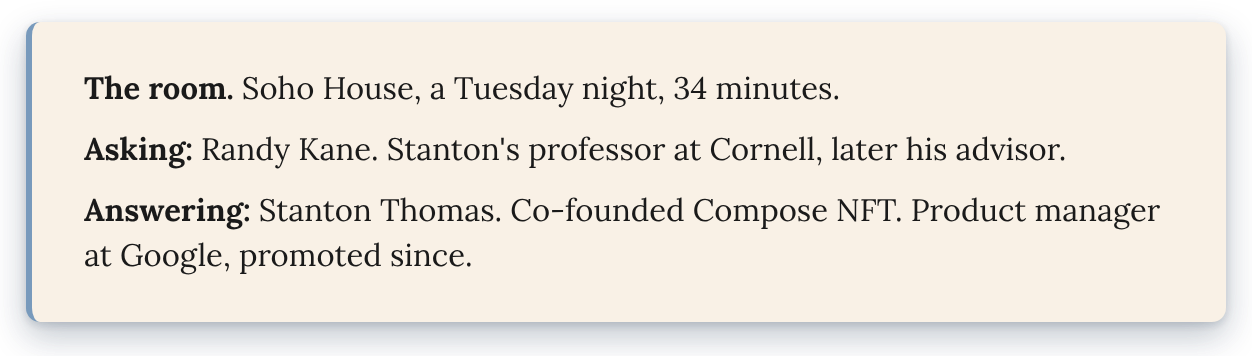
Most of what I write here is about building. Stanton took the other path, and I wanted the honest version of what it cost and what it bought. Soho House, a Tuesday night, thirty-four minutes. Every quote is his, cleaned for print, approved by him before this went out.
The founder years
“Did we build a company on a dwindling trend?”
RANDY
ComposeNFT, not the pitch version:
STANTON
We saw an opportunity to use a smaller artist's organic fan base, pay the artist in ways that made sense, and bring fans closer. The artist uploaded a song, we turned it into an NFT, and fans could buy pieces of it. “I own a piece of that song.”
RANDY
Then the question I warned him would be pointed. What was the first thing you got wrong, and how long did it take to admit it?
STANTON
You need to talk to the customer, and a lot of them, to validate that you're solving a real problem. We had the idea, talked to a few people who said, “sounds great,” and started building. We were burning engineering hours without me going out and talking to 500 artists and asking, “Is this a problem all of you have? Would you be part of our MVP?” I was too focused on the technical capabilities of building a platform.
RANDY
He had two co-founders, both engineers. One is now at Google with him. I asked whether they compounded the mistake or just agreed with each other.
STANTON
Engineers want to build great things. As the product person, you're responsible for identifying: what we're building, why it's a problem worth solving, and our plan to scale it. The product itself worked flawlessly. But engineers want to build. You need to give them the right direction, or they'll build a great functioning product in the wrong direction.
RANDY
I've watched that sentence play out in consulting for decades. The work is excellent. The brief was wrong. Then the moment he knew.
STANTON
When FTX went under, that started the bear market for crypto and NFTs, in my mind. The narrative shifted from “web3 is the future” to “web3 is a scam.” We were selling NFTs, and NFTs are bought with cryptocurrency, so it hits the business model, revenue, all of it. Demand slowly fizzled out.
RANDY
And how long it took him to act on it.
STANTON
Another mistake was being in denial. As a founder, you don't want to see your baby go under, so you try everything. In retrospect, I should have decided faster. You and I talked about direction and raising money, and I kept dancing around the elephant in the room: Is there demand? Did we build a company on a dwindling trend?
I remember those conversations. I was dancing too. Advisors do that when they like the founder more than the numbers.
RANDY
What did two years as a founder give him that a job couldn't?
STANTON
The scrappiness to build products. Taking something from zero, something in my head, to one, a working product in front of people. Even as a product manager at a big company, you may own a piece of a product. A zero-to-one product is a rare experience. Requirements, prototyping, early versions that broke, onboarding our first customer. The whole journey.
The decision
“I saw it as an at-bat. It's a nine-inning game. I just struck out on the first at-bat.”
RANDY
This is the part I wanted to hear. Not that he joined Google, but how he made the decision.
STANTON
Aside from it being Google, I'd worked with people on the team before at VMware. They were building a very exciting security product, and it operated like a startup within Google. That's what excited me. I looked up to those people. I still do. Compounded by the fact that ComposeNFT wasn't doing too hot.
And, I pointed out, this one could actually pay him. “Very true,” he said.
RANDY
The hard question. Did he ever feel like a failure? I was there for those decisions, never thought of him that way, and told him so before he answered.
STANTON
In the moment, I felt like, wow, I led something that failed. This is not the outcome I'd talked about. But when I zoomed out, I saw it as an at-bat. It's a nine-inning game. I just struck out on the first at-bat. I will have more at-bats.
I asked if that was hindsight talking. He said no; he really feels it, and that in the moment he felt responsible and asked what he could have done better. Both things at once.
RANDY
Then the one I said I didn't want a LinkedIn post for… When should a founder know to quit?
STANTON
That's a very hard question. Market timing is hard. You could try at something for ten years. The telltale sign is when the founder's heart is not in it. If you don't feel a burning desire to get up and do the damn thing every day, you should quit, because you're competing against people who do. Maybe my heart is in it, and on the eighth product iteration we get it right. But if it's not, you're going to lose. A thousand percent, eventually.
I pushed: so you have to be introspective. He said yes. Do I feel this way, yes or no? If not, why? Decide from there.
That is the quit test. It is the paid section of this post, turned into something you can fill in.
The view from inside
“If we move a button, we have a hundred data points before we decide.”
RANDY
Which founder habit got him in trouble in the first six months, and which one got him promoted?
STANTON
Trouble: trying to move too quickly. I was used to a place where we could build something fast and launch it. At a big company, it's harder to ship, and that's by design. You're shipping for billions of people. Moving too fast in development and pushing teams hard can sometimes be useful. Sometimes it's a hindrance.
Promoted: focusing on the right problem to solve, which for him means talking to customers.
STANTON
You hear their problems straight from their mouth, and you get to go solve them.
The same founder who skipped the 500 artists got promoted for talking to customers. He knows. That is the point of the post.
RANDY
What has he learned at scale that he wishes he'd had as a founder?
STANTON
Seeing products launch at scale, seeing how things are planned. There's a system that works. It's hard to replicate in a small company, but once it grows to a medium size, having that rigor behind decisions matters. There's data behind every little thing we do. If we move a button, we have a hundred data points before we decide.
I learned that from big companies too. When I built the streaming platform at DanceBody, there was nothing to copy, but I knew that seeing how customers actually watched the videos would make our team better at making them. Early-stage companies rarely think that way. The best of both is a small company that moves fast and still aims to do more.
RANDY
Would he start something again? Absolutely, he said, and he thinks about it often. So how does he think of himself now, a founder at Google or a Google person who used to be a founder?
STANTON
I'm in the training ground for running a company, whether I start one myself or eventually join one and work my way up.
The questions for current students
“Your career will be full of failures. Fail early so you can learn from them.”
RANDY
Start something out of school or go inside first? I get this one more than any other.
STANTON
There's never a right time. Anyone who gives you a clear answer is probably lying. Learning how things are done in a company matters; it's rare for someone with no experience to walk in and become the next Mark Zuckerberg. That said, coming out of school, you can take on a lot of risk, because you have a whole career ahead of you. Your career will be full of failures. Fail early so you can learn from them.
Building on the side while employed? Check the guidelines first, because the company can own it. If it's allowed, he's for it.
RANDY
Does a failed startup on the resume help or hurt at a big company?
STANTON
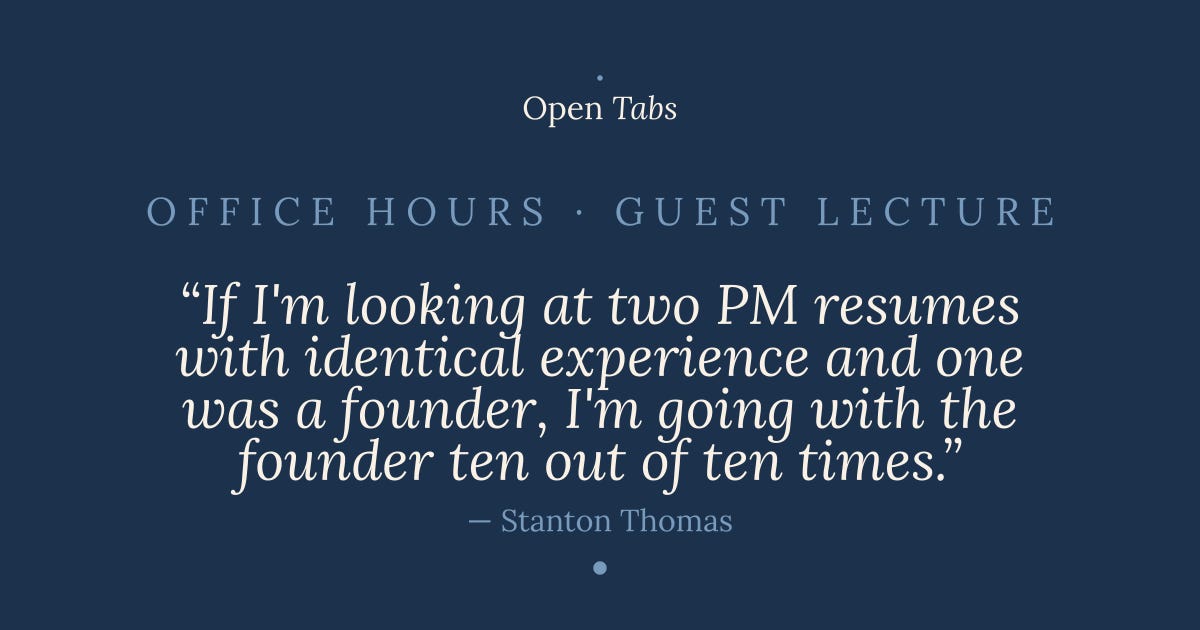
It helps. If I'm looking at two PM resumes with identical experience and one was a founder, I'm going with the founder ten out of ten times. They have lessons you could never learn otherwise.
At a substantial company, you have a huge safety net. You make a wrong decision, the organization suffers for a little while. As a founder, a couple of wrong decisions and the company fails.
RANDY
And people are relying on you. I told him a story I'm not sure I've told in class.
Six or eight months into Acquis, we hired our first employee. He still works there. A couple of months later, two things happened in the same week. We signed the world's largest bank as a client, and he and I were about to travel five straight weeks, out Sunday night and back Thursday, to five cities. The week before we left, he got married. My co-founder and I attended. It was the three of us in the whole company.
His father came up to me at the wedding reception and asked how business was. A normal cocktail-party question, except he wasn't asking it that way. His look said, “You're paying my son's rent, and he just got married.” I answered him directly: what I thought, where we were going, and how I felt. That was the end of 1998, twenty-eight years ago, and I have never forgotten the question. It shaped the culture of every company I've built since.
The closer
RANDY
Last question. A student from our class texts you tonight with an offer letter from a big company and a half-built product. What's the one sentence you send back?
He wouldn't send one sentence. He'd push.
STANTON
All offers are not the same. If you tell me you're starting your career at Google, I know, as someone who works there, that it's a great launchpad. And a half-built product is exactly that. I've built products. I'd ask more questions. Why did you build it? Who have you talked to? What's your go-to-market plan? It's not a decision where you just say, “go found a company.” Weigh all the options.
My take, since this is still Office Hours. The job didn't end with the founder. Watching a billion-dollar company decide where (and why) to build functionality is the most expensive product education on earth, and someone else pays for it. The question isn't build or join. It's whether you can answer the father at the wedding honestly, and whether your heart is in it enough to believe it and back it up. Stanton could; it wasn't, and he said so. That is the whole skill.
Below the line: his four questions as a worksheet, the quit test as a one-page self-check, and two questions of mine from 1998. Print it.
