


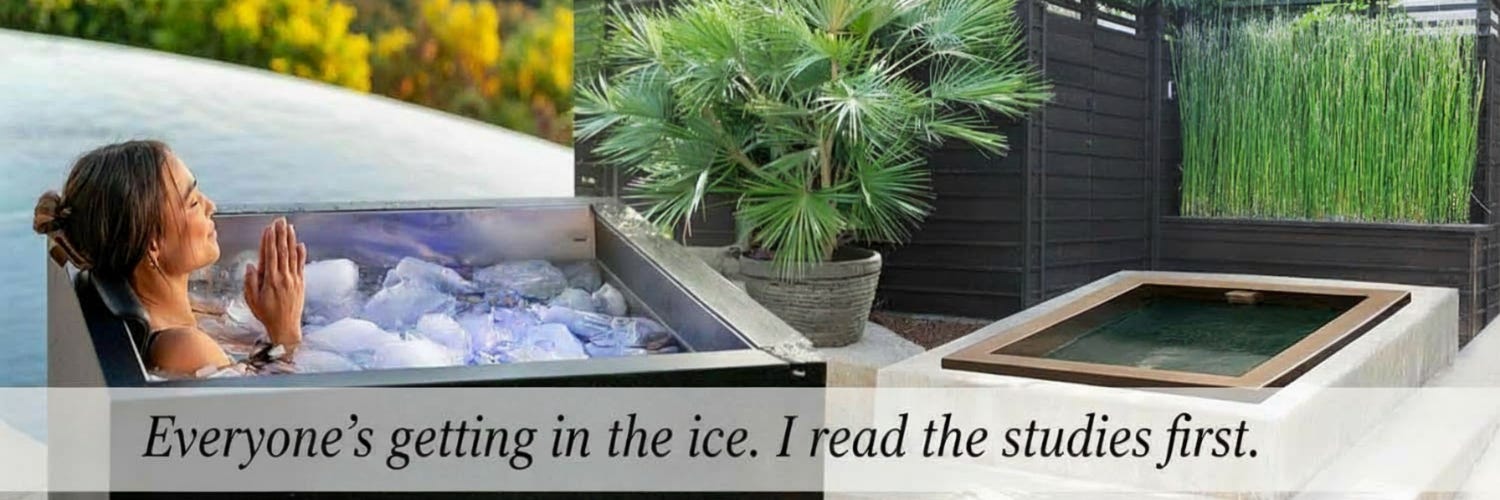
Cold is having its moment. Wim Hof made it a personality trait, the podcast guys made it a protocol, and somewhere along the way, a three-minute shiver turned into a $10,000 piece of furniture. So I did what I do with any pitch that’s suddenly everywhere: I asked what it’s actually claiming, and whether the evidence backs it.
Here’s the surprise: cold mostly passes diligence. What’s being sold around it mostly doesn’t.
What the cold actually does — the part that’s real.
The best evidence here isn’t a vibe; it’s a 2025 systematic review and meta-analysis in PLOS One pooling 11 studies and more than 3,000 people. It found that cold-water immersion genuinely reduced stress — the effect was strongest about twelve hours later — and improved sleep quality and overall quality of life. Separate meta-analytic work supports cold for post-exercise recovery and reduced muscle soreness. So if your claim is “cold helps me recover, sleep, and feel less stressed,” the science is more or less on your side.
Now notice what the same research didn’t find: no consistent mood boost, no immune superpowers, and — my favorite — a brief spike in inflammation right after immersion, not the magic anti-inflammatory reset the influencers promise (albeit, the consistent use of cold therapy can reduce inflammation from an injury). The benefits are real, and they’re specific. They are not “cold cures everything.”
Why it works — the part the bros get half-right.
Here’s the mechanism, because it explains both the high and the calm. The instant you hit cold water, your body panics in a useful way: it dumps norepinephrine (a.k.a. noradrenaline), the alertness-and-focus chemical, sometimes by a multiple of baseline. That’s the rush — the wide-eyed, “I can do anything” feeling people get addicted to. It’s real, and it’s why a cold plunge can feel like a double espresso without the jitters.
The more interesting part is what happens after. Cold is a hormetic stressor — a small, controlled dose of stress that nudges your body to adapt and come back steadier, the same way a hard workout does. Your nervous system spikes sympathetic (”fight or flight”) on entry, then rebounds toward parasympathetic (”rest and digest”) once you’re out and warming up. The leading explanation for that stress reduction showing up twelve hours later is exactly this adaptive rebound — you’re not relaxed in the ice, you’re relaxed because you trained the system that handles stress. (Mechanisms are the best current explanation, not settled law — but they line up cleanly with what the trials measured.)
This also explains the ceiling. A controlled stressor helps; an overwhelming one doesn’t. Colder and longer isn’t more adaptation — past a point it’s just more stress. Which is the perfect segue to the part you’re being oversold.
Where the theater begins — the part you’re overpaying for.
Three slides in this “deck” should make you put your pen down.
Slide one: cryotherapy. Standing in a −200°F nitrogen tube for three minutes is the most theatrical version of cold and the most hollow. The FDA’s own review found no evidence that whole-body cryotherapy treats any medical condition — and flagged real risks, including frostbite and asphyxiation. A $40 cryo session is a colder, riskier, evidence-free version of something you can do in your own bathtub.
Slide two: the $10,000 tub. The chilled, chrome, app-connected plunge tubs run five to fifteen thousand dollars. Here’s the diligence question no founder wants: what does that buy you over a chest freezer and a bag of ice? Physiologically, just about nothing. Cold water is cold water. You’re paying for design, a logo, and a sense of seriousness. I’ve tried this - both actually - and I can tell you the freezer works just as well; it just doesn’t look as good in your friend’s backyard!
Slide three: the overclaims. Fat loss, “metabolic transformation,” immune fortification — these outrun the data the second the camera turns on. The honest version of cold is unsexy: a little better recovery, a little better sleep, a little less stress. That’s a good product. It just isn’t the miracle on the label.
A quick word on the cooling beds.
Adjacent to all this is the Eight Sleep crowd — cooling your bed instead of yourself. Different mechanism (your core temperature drops at sleep onset, and cooling helps that along), and it’s legitimately supported. But it’s the same lesson in nicer packaging: the temperature effect is real; the $3,000-plus price and the monthly subscription to unlock features are the performance. A ~$200 cooling pad does the physics.
How to actually start — without buying anything.
If you want the real benefits, here’s the unglamorous version that costs roughly nothing to start.
End your shower cold. 30 seconds to start, working up to a minute or two. This alone gets you the norepinephrine effect on most mornings.
Graduate to immersion. A bathtub with a few bags of ice, or — if you fall in love with it — a chest freezer conversion. You do not need a branded tub.
Temperature & time: cold enough to want out (roughly 50–59°F / 10–15°C), for 2–5 minutes. Colder and longer is not better; it’s just more stress.
Frequency: a few times a week is what the studies that found benefits actually used. This is a habit, not a heroic event.
Breathe slow and get out before you go numb. The goal is a controlled dose, not a dare.
Safety first: skip it entirely if you have a heart condition, never plunge alone, and warm up gradually afterward (no scalding shower straight out).
The verdict, pitch-meeting style.
Cold passes. Of the eleven things I graded in the field guide, cold plunge was one of the few I filed under Worth It — and digging in didn’t change that. But the category is a textbook case of the tell I look for in every deck: someone pricing a discipline like it’s a technology. The discipline — get in cold water a few times a week — is nearly free and genuinely works. Everything bolted onto it is the markup.
So: get cold. A cold shower, then a chest freezer if you fall in love with it. Skip the cryo tube and the five-figure tub. The cold is real. The price tag is the performance.
The Operator’s Eye · Worth It or Wellness Theater. My experience, POV, and what works for me as an athlete, operator, and investor — not medical advice. Real caveat: cold-water immersion can be dangerous with a heart condition, and hypothermia is real — don’t go too cold, too long, or alone.
Open Tab → I dove deeper: this is the first single-subject teardown spun out of the wellness field guide. More coming — one buzzy product at a time.
To be the first to read my entrepreneurial thoughts, about health & wellness and other sectors, consider becoming a subscriber!