


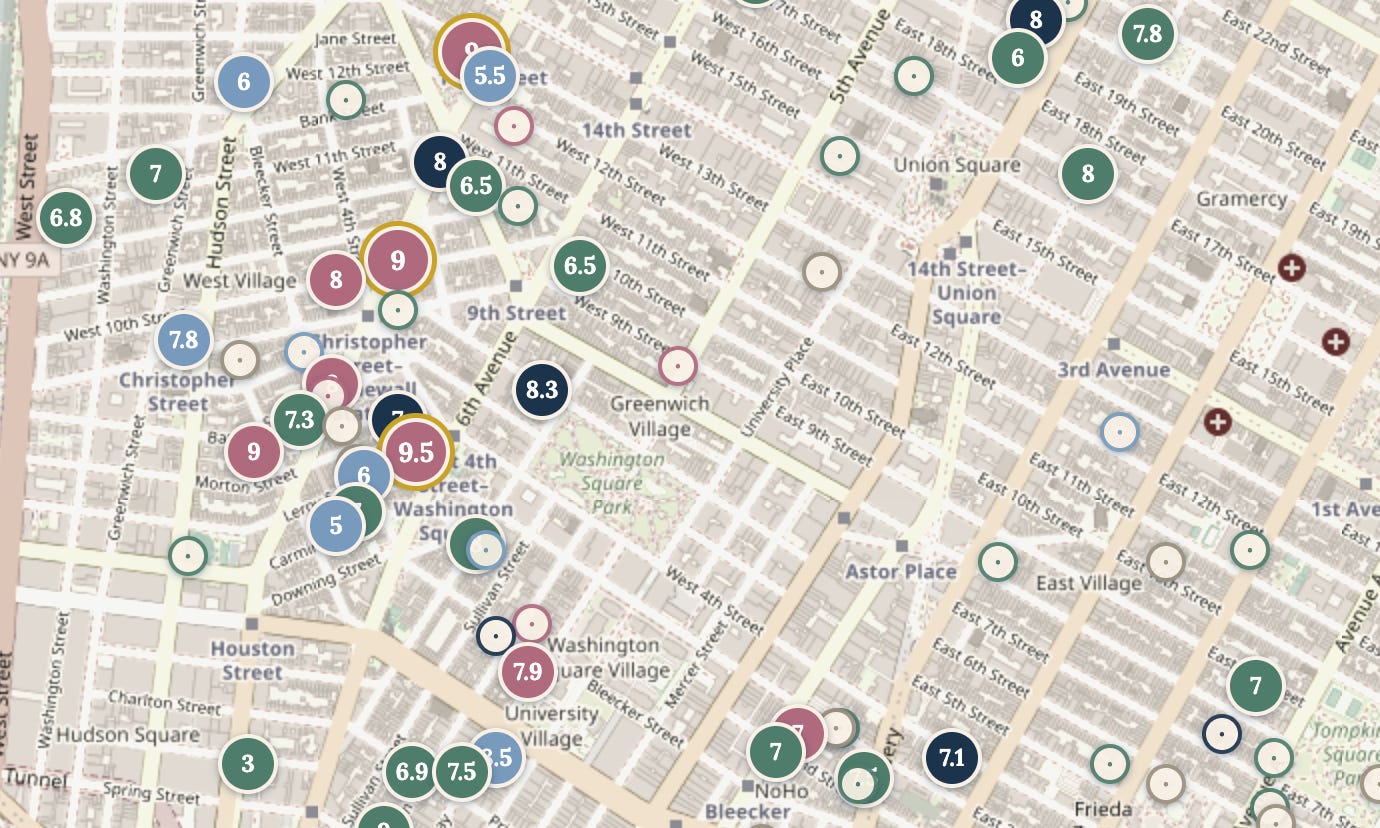
There are 284 pins on my map. 169 of them carry a score from 0 to 10. Before you trust a single one of those numbers, you should know exactly what they mean and how they get there.
Here’s the doctrine.
The scale is 0 to 10, and most of it gets used.
A 9 or above means I’d rearrange my schedule to eat there again. It means the food, the service, and the room all held up under scrutiny — not one great dish carrying two hours of mediocrity. There are very few of them on the map, and that’s the point. If everything is a 9, nothing is.
A 6 is not an insult. A 6 is a real restaurant that fed me a real meal but gave me no reason to come back. You’ve eaten at a hundred 6s. So have I. The difference is that I write it down.
Below that, I tell you why. Cuba Café is a great example (5/10). A Cuban restaurant in Chelsea should be great — it’s far from that. New York City has some of the best restaurants (fancy and not) in the world, but it always seems to lack a truly authentic Cuban restaurant rooted in tradition. Having spent so much time in Miami, and every time going out to eat (or take away) in Little Havana, whether at the old traditional spots or the newer takes on it, I love Cuban food. Frankly, it would be on the list of choices as a last meal! NYC disappointingly doesn’t cut it, and Cuba Café doesn’t even seem to try.
I score what I’ve eaten. Full stop.
First visits count. Some critics wait three visits before they’ll commit to a number (I’m not a professional critic!). I understand the impulse. I reject it. You don’t get three visits — you get one Friday night and one reservation, and you want to know if it’s worth it now. Being early is the point. If a restaurant is great in month two, you deserve to hear it then, not after every list has already told you.
Brand-new restaurants count for the same reason. A score is a snapshot with a date. If a place improves or worsens, the score can change. It has.
Meals on dates count too. I’m not going to pretend a meal didn’t happen because I was enjoying the company—I’d be lying if I said the person across from me didn’t influence the experience in some way. But you might be going with someone special, too, and want to know about that. How they enjoy it and how we talk about the food (dessert included 😉) matters, in my opinion. Restaurants are not just about food; hospitality is their industry. The only thing that stays home on a date is the production — no filming the table, no turning dinner into content. The eating still counts. The scoring still happens. It just happens later, quietly.
Misses are owned.
There are pins on my map labeled “A Miss — Mine.” Places I called wrong. They stay up. I don’t quietly re-edit history so the record looks smarter than I was. If you’re going to trust the 9s, you need to be able to see the misses sitting right next to them, because a map with no misses is a map that’s been cleaned for your benefit, and cleaned maps are worthless.
There are also 41 pins marked “Gone.” Closed. They stay too. A map of a city’s restaurants that pretends nothing ever dies isn’t a map of a city.
Nobody pays for my opinion. You do.
No ads. No sponsors. No press meals. I pay for every plate on that map, which means every number on it answers to exactly one person: the reader. I’d rather lose you to an honest 6 than keep you with a padded 8. The whole model only works one way — if a restaurant could buy a point, the other 170 scores would be worth nothing.
So what are you actually trusting?
Not my palate being better than yours. It might not be. You’re trusting that the number was arrived at the same way every single time: I sat down, I paid, I ate, I judged, I wrote it down — whether it was a first visit, a date, a place five months old, or a place I got wrong. Consistency matters — always (huge lesson I learned in BBQ → “Low and Slow: A Love Letter to American Barbecue”)
284 pins. 169 scores. One method.
The map lives at opentabs.readopentabs.com/TheMap. The 16 most overrated famous restaurants in NYC sit on it public and free — that’s the part I take the most heat for, so start there. The rest — every score, every verdict, the Top 10 — comes with the paid key, and the key answers to the same method you just read.
If you’re going to trust the numbers, you should first know how they’re made. Now you do.
The Long Table — food, restaurants, and the New York that survives at the table. My taste, not a star rating. This is my experience and my palate, not a critic’s star rating. Reasonable people love restaurants I found merely fine, and that’s the correct outcome.
Open Tab → I dove deeper: the full, filterable NYC restaurant Map — the comprehensive one, not the argument — is LIVE now for paid subscribers.
A 284-pin map scored 0–10, and the misses are left up where you can see them. No ads, no sponsors, no press meals — nobody pays for my opinion. You do. The full map is at opentabs.readopentabs.com/TheMap.
The question I get most: 'doesn't a first-visit score punish a restaurant having an off night?'
Sure. And waiting six months punishes you, the person trying to book a table this week. I picked a side. If a place recovers, the score moves and I say so — the date stays on the snapshot either way.