


I paid for my first David bar when it first hit shelves in New York — my own money, $5.34 at Happier Grocery. It wasn’t great and was sort of greasy. Flavor was nothing special — and I’m into food.
But the shiny label stopped me: 28 grams of protein, 150 calories, zero sugar. I’ve spent more of my life evaluating businesses than reading nutrition panels — sixteen years building a consulting firm, then sitting on the investor side of the table — and when a number looks that good, my instinct isn’t “is it healthy.” It’s “show me the machine behind it.”
Let me say the fair part first, loudly, because the internet won’t: the number is real. 28 grams of complete protein for 150 calories is the best macro line in America, and it isn’t close. David publishes third-party protein testing — Light Labs, December 2025 — 65 of 65 tests passed. The blend (milk protein isolate, whey, egg white, collagen) hits a complete amino profile. If your only constraint is protein-per-calorie, David wins on the spreadsheet, full stop.
Hold onto that concession. It’s the last thing in this story that survives contact with the evidence.
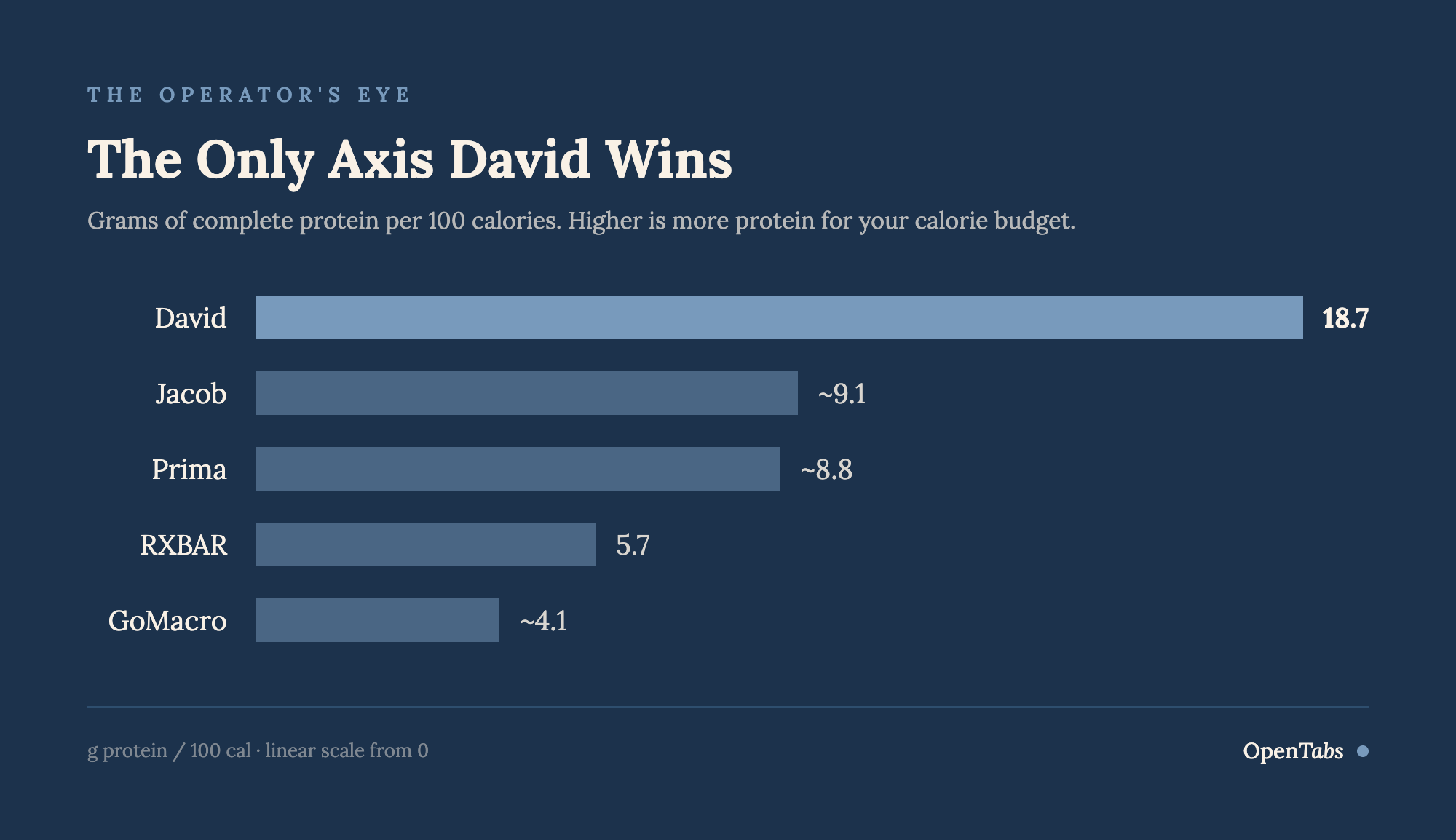
Here’s the mechanism. David gets to 150 calories by swapping most of the fat for EPG — esterified propoxylated glycerol — a modified plant fat that’s about 90% non-digestible. It’s a GRAS ingredient; the FDA reviewed the safety dossiers and issued “no questions” letters. And because most of it passes through you unabsorbed, it goes on the label at roughly 0.7 calories per gram instead of fat’s usual 9. It’s legal. It’s clever. (That greasy texture I noticed on day one? That’s the fat that isn’t supposed to count.)
Then David did the truly smart thing: they bought Epogee, the company that makes EPG. As business, acquiring your one irreplaceable supplier is textbook — and that’s precisely the problem. They didn’t vertically integrate the nutrition. They vertically integrated the illusion. The moat isn’t a better bar; it’s exclusive ownership of the accounting method that makes the label possible. (Three small brands that built products on EPG are now suing over that supply cutoff — an antitrust fight still in court as I write this.)
Now the machine. Peter Rahal founded David after selling his first company, RXBAR, to Kellogg’s for around $600 million. (Hold that thought — RXBAR comes back at the end, and it’s the best part.) David raised roughly $85 million, and the company says it was on pace to surpass $100 million in revenue in year one; Rahal is targeting $300 million for 2026. Their numbers, not audited ones — but even directionally, that’s one of the fastest food launches ever.
How? Not ads. The documented playbook: 20,000 free samples seeded to influencers before launch, a 40,000-person waitlist, and — the clever part — megaphones that own a piece. Andrew Huberman isn’t a hired spokesman; he’s an investor and a pitchman, same mouth, both jobs. Peter Attia — roughly two million Instagram followers — invested in the seed round and was Chief Science Officer until he stepped down in February 2026. Attia stepped down after his name appeared roughly 1,700 times — including email exchanges he himself called ‘indefensible’ — in the DOJ’s January 2026 Epstein files release. He has not been accused of any wrongdoing.
Think about that structure for a second. When a podcast host takes cash to read an ad, disclosure rules kick in — you know it’s payola. When the same host owns equity and just... enthuses about a product he happens to hold a stake in? The disclosure gets a lot fuzzier, and the enthusiasm reads as science. I paid for my greasy bar. The loudest voices telling me it was the future of protein own a piece of the company. That’s not a scandal — it’s just worth knowing whose mouth the megaphone is attached to.
The lawsuit — here’s the honest version. In January 2026, a federal suit alleged that independent testing found 263–275 calories and 11 to 13.5 grams of fat per bar, versus the 150 calories and 2 grams on the label. David disputed the methodology: the plaintiffs’ numbers came from bomb calorimetry, which burns the bar and measures total energy — while EPG’s whole premise is that your body doesn’t absorb most of that energy. Rahal called the suit “frivolous.” On March 30, 2026, the plaintiffs voluntarily dismissed it — without prejudice, meaning they can refile. No ruling, no explanation. So the fair line is not “David got caught.” It’s: someone alleged the calorie math only works inside David’s own accounting frame, David said they measured wrong, and the question left the courtroom before anyone answered it.
Your gut gets a vote too. The sweetener stack is four deep: allulose, about 8 grams of maltitol, sucralose, and acesulfame-K. Allulose is generally well tolerated — it gets a bad rap it doesn’t deserve. Maltitol is the classic gut-bomb, and the effects are dose-dependent: one bar, most people are fine; two or three, the odds turn against you. EPG itself was tolerated at around 10 grams a day in studies, with GI issues showing up at 25-plus — so the multi-bar-a-day crowd is running an experiment the label doesn’t mention. None of this will wreck you. At one bar it probably won’t. But “engineered to be eaten in volume, uncomfortable in volume” is a strange spec sheet for a health product.
So what do I actually eat? After the David experiment I went down my own rabbit hole — labels, ingredient decks, the works — and came out holding Jacob (~20g grass-fed protein, ~220 calories, honey and dates, no seed oils, no sugar alcohols). It reads like a recipe instead of a lab order. I also tried Prima (whole-food, ancestral-leaning): good, but — irony noted — greasy in its original form. They’ve since reformulated to 21 grams of protein and, reportedly, less “grease”; it’s back on my retest list, which is exactly how this should work. GoMacro is clean too, but at 250–290 calories for 10–12 grams of protein you’re getting granola-bar macros at small-meal calories — and the taste, charitably, is something a squirrel would respect more than enjoy.
Notice the trade. Jacob and Prima cost you ~70–90 more calories and a couple more dollars to get out of the lab and into actual food. If your only constraint is calories — you’re cutting, you’re deep in a training block — David’s spreadsheet win is genuinely useful, IF it’s accurate, and “engineered” isn’t automatically “bad” (whey isolate is engineered too). The right question is what’s your actual constraint. If it’s calories, David wins on paper. If it’s your gut, or your patience for ingredient lists that need a chemistry degree, eat the food and eat the calories. These days, there’s always a Jacob Bar — Vanilla — in my bag.
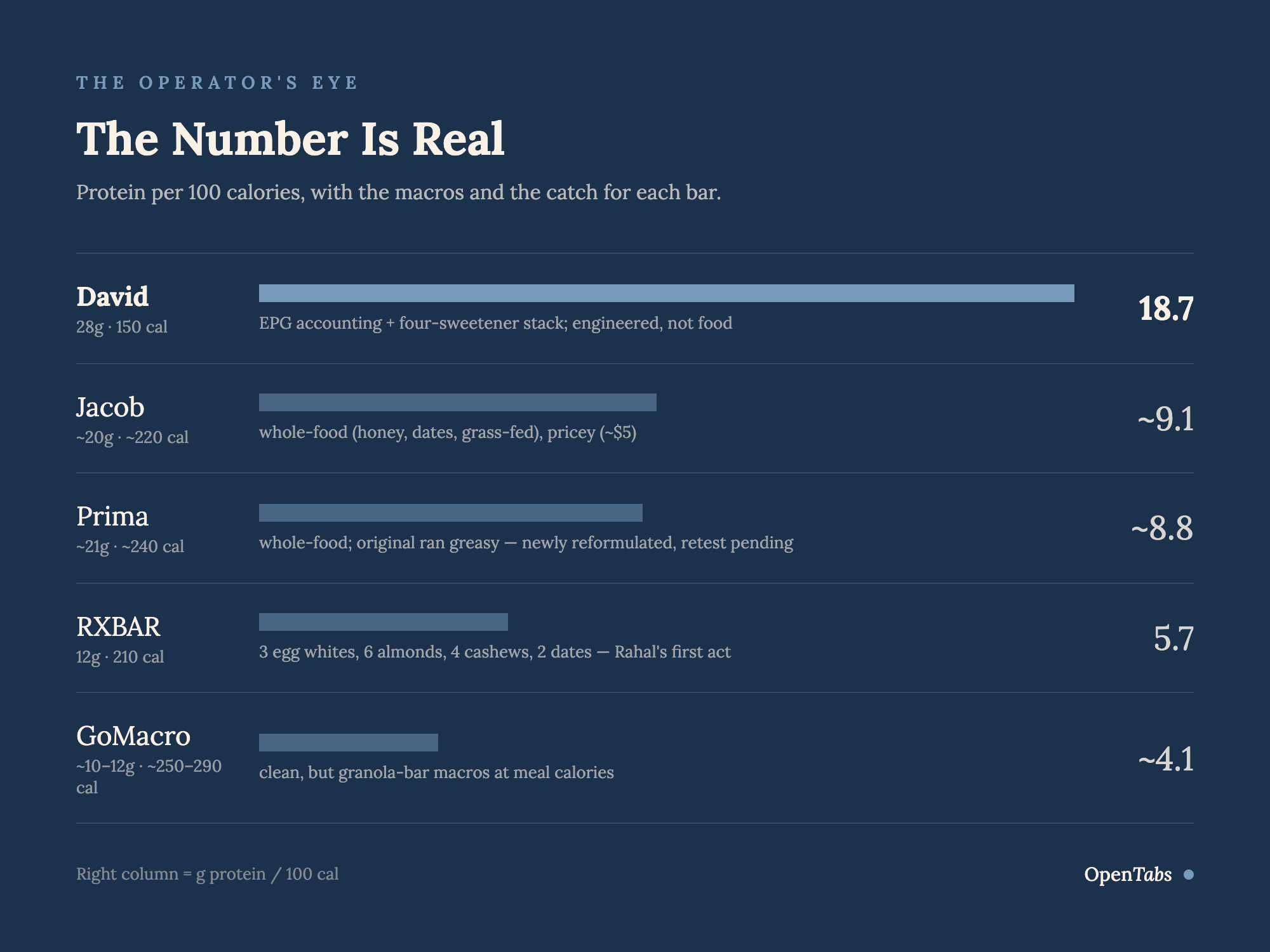
And here’s the part I can’t get over. While I was comparing labels, I pulled up RXBAR — Rahal’s first company, the one Kellogg’s paid $600 million for. Read the front of the wrapper — it IS the pitch: “3 Egg Whites, 6 Almonds, 4 Cashews, 2 Dates. No B.S.” Twelve grams of protein, 210 calories. That’s it — the ingredient list famously fits on the front. No EPG, no maltitol, no sucralose, no acesulfame-K. As a food guy, here’s my verdict: RXBAR is better for you than David. Not on the spreadsheet — on the shelf, in your body, as food.
Sit with that. The man who built the honest bar built the engineered one. First he made the bar whose entire brand was printing “No B.S.” on the wrapper, and sold it for $600 million. Then he raised $85 million to build the bar that needs an accounting method, a four-sweetener stack, and a supplier acquisition just to say 150. Both are legal. Both are brilliant business. Only one of them reads like food.
And the honest one is still sitting right there on the shelf.
🏪 LINK: The shelf: every bar that survived this teardown. (affiliate link — I only list what I actually rebuy)
Open Tab → I dove deeper: I read the lawsuit filings, the ingredient decks, the GRAS letters, and the cap table so you don't have to. This is experience, POV, and what works for me as an athlete, operator, and investor — not medical advice. If you've got gut issues, your gut is the expert, not me.
I will be covering a wide range of topics from an operator’s viewpoint with this series so if you’d like to be the first to know, consider subscribing!
If there are topics you are interested in, please comment or post to the chat.